Speed to Lead Statistics: What the Research Really Says
Short answer: the best-documented speed-to-lead findings are that the average company takes about 42 hours to respond to a web lead, that firms responding within an hour are about 7 times more likely to qualify the lead (Harvard Business Review, 2011), and that calling within 5 minutes instead of 30 makes reaching the lead about 100 times more likely and qualifying it about 21 times more likely (MIT/InsideSales, 2007). Several other popular numbers, like "78% of buyers choose the first responder", have no traceable source.
Below: the statistics you can cite, where they come from, what they actually measured, and the ones to stop quoting.
The verified statistics
Harvard Business Review: "The Short Life of Online Sales Leads" (2011)
Researchers audited how 2,241 US companies responded to web leads and analyzed lead data from a larger set of firms. Key findings:
- 42 hours: the average response time to a web lead, among companies that responded within 30 days.
- 23% of companies never responded at all.
- About 7×: firms that tried to contact leads within an hour were nearly seven times as likely to qualify them as firms that waited longer than an hour, and more than 60 times as likely as those that waited 24 hours or more.
Source: Harvard Business Review, March 2011.
MIT / InsideSales: Lead Response Management Study (2007)
Led by Dr. James Oldroyd at MIT, with InsideSales.com, using three years of data from six companies: more than 15,000 web leads and over 100,000 call attempts.
- 100×: the odds of contacting a lead drop about 100 times between calling within 5 minutes and calling after 30 minutes.
- 21×: the odds of qualifying a lead drop about 21 times over the same window.
What it didn't measure: closed deals. It stops at contact and qualification, so it's not proof that speed multiplies revenue 21 times. Source: the study summary (PDF).
Statistics to stop quoting
- "78% of customers buy from the company that responds first." Usually credited to a "Lead Connect survey", but no published study can be found. Don't put it in your pitch deck.
- "35–50% of sales go to the vendor that responds first." Widely repeated and attributed to InsideSales, but hard to trace to a methodology. If you use it, say it's an industry estimate.
- "Leads go cold in exactly 5 minutes." The 5-minute window comes from comparing 5 vs 30 minutes in the MIT study, not from a measured cliff at minute five.
What the data means for you
- Measure your own response time. Submit your own form at different hours and time how long it takes to get a call. Most teams are surprised.
- Cover nights and weekends. A lot of leads arrive outside office hours; that's where the 42-hour averages come from.
- Call, don't just email. The studies above measure reaching and qualifying people; a live conversation does both at once.
- Automate the first call. No human team can call every lead within a minute, at any hour. That's exactly what an AI appointment setter is for.
How CallBooker turns this into meetings
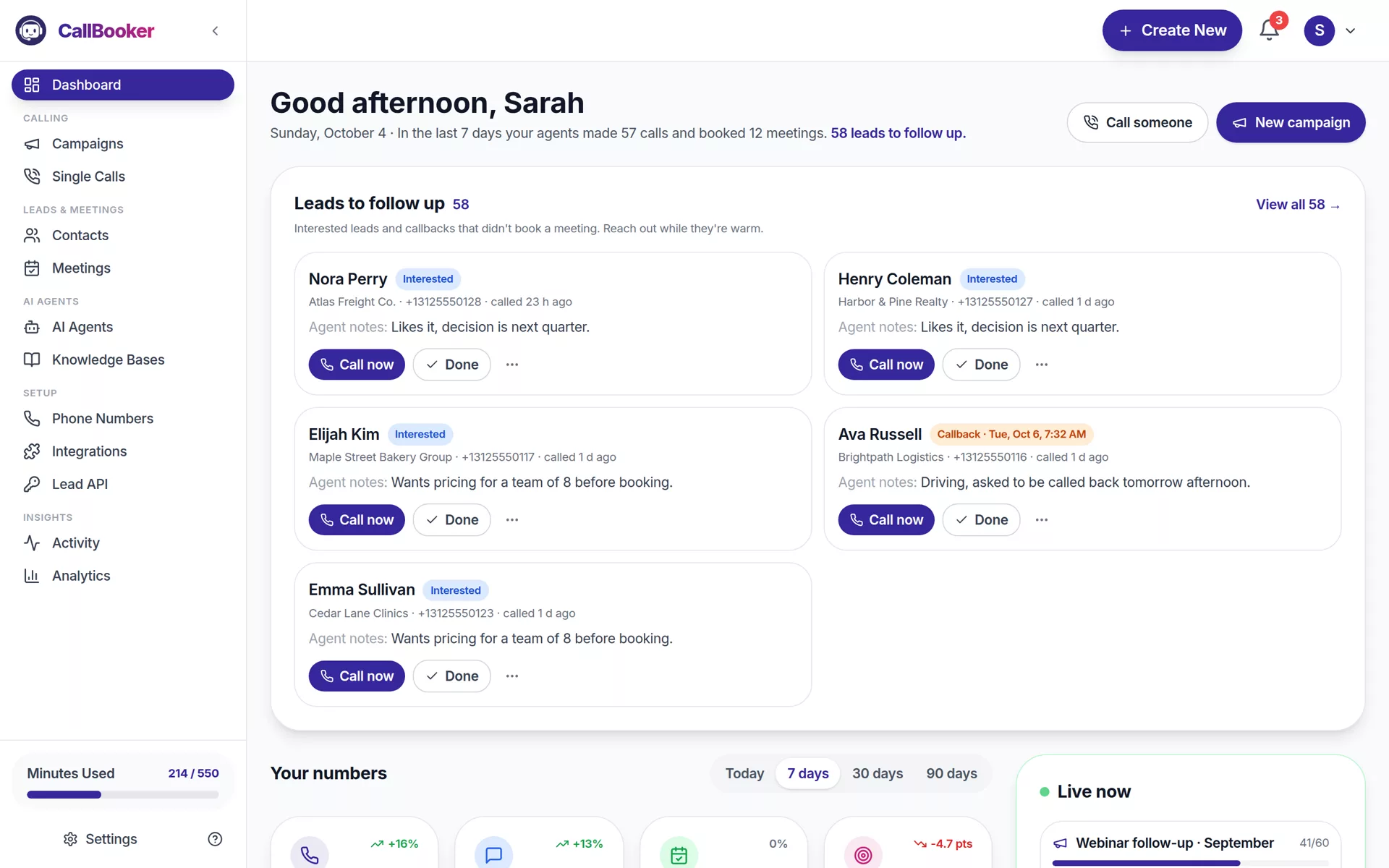
CallBooker connects to your forms through its Lead API, Zapier or Make and calls each new lead within seconds. The AI agent answers questions, handles objections and books the meeting on your calendar. Leads who are interested but not ready land in a follow-up list. See how to call web leads in under 60 seconds, or get a call from our AI to experience the speed yourself.